

Do You Need a Meralco Upgrade or Permit for a Home EV Charger?
A Philippine guide to electrical capacity, Meralco service upgrades, LGU permits, condo approvals, and documents to prepare before installing a home EV charger.
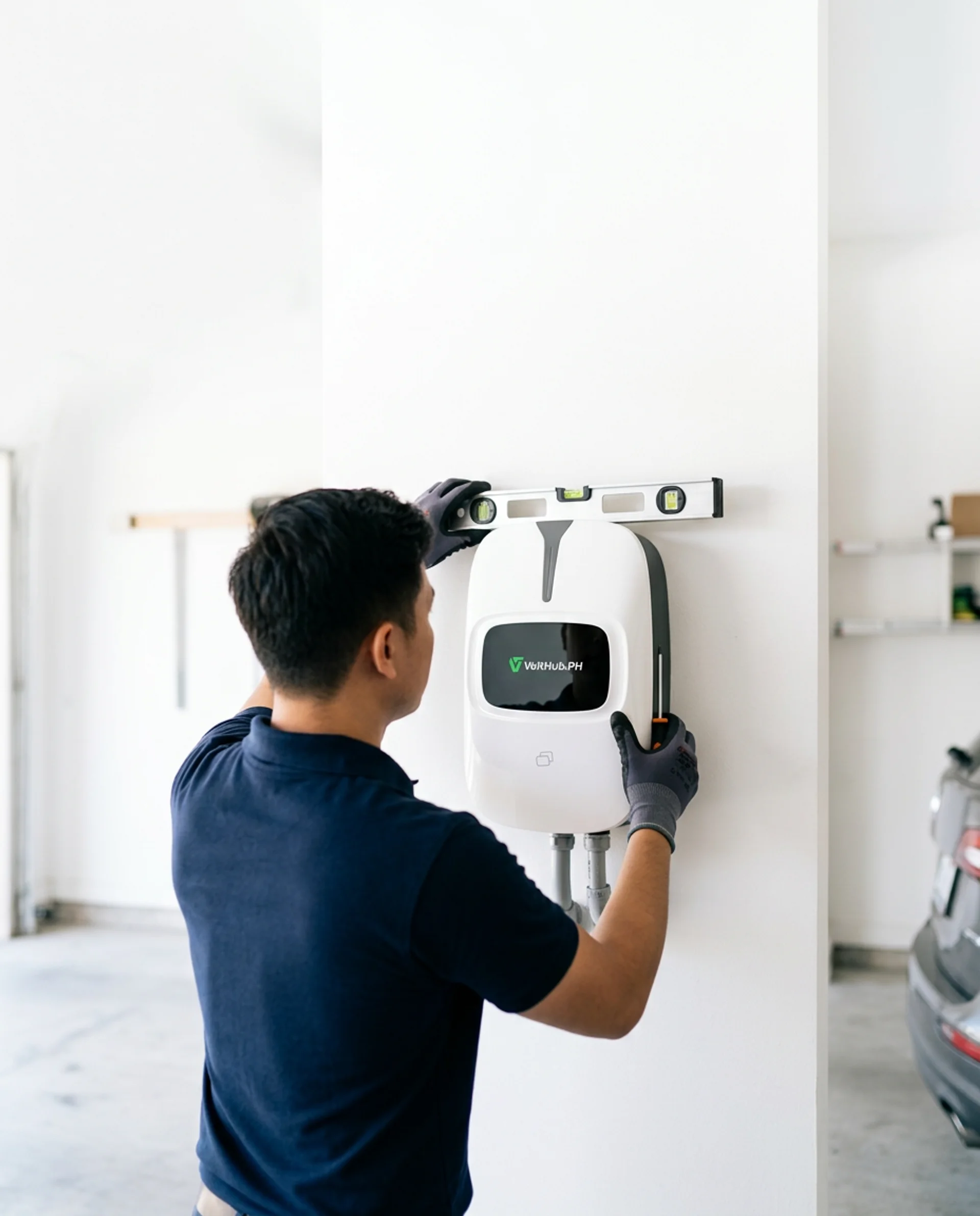
Not every home EV charger installation automatically requires a Meralco service upgrade or the same permit. An upgrade is generally relevant when the property's existing service, panel, or available load cannot support the dedicated charging circuit, or when the meter or service entrance must be changed.
Permit and inspection requirements depend on the electrical work, the local government unit, and any condominium or building rules. The safest sequence is to have the site assessed first, then confirm the exact utility, LGU, and property approvals before installation.
Short answer: adequate existing capacity may mean no Meralco service modification. Increasing the service load or changing the meter or service entrance can trigger Meralco's Modify Service process. New or altered electrical work may also require LGU approval or inspection, while condominiums and rentals usually need written property approval.
Home EV charger approval guide at a glance
| Installation situation | What may be required | Who confirms it |
|---|---|---|
| Existing service and panel have adequate capacity | A dedicated circuit, correctly sized protection, grounding, testing, and any LGU-required electrical permit or inspection | Qualified installer and local building official |
| Service load must increase, or meter/service entrance must change | Meralco service modification, electrical plan, inspection, and potentially an adjusted bill deposit | Meralco and the local building official |
| Condominium, rented property, or cable route through common areas | Written property approval, work permit, cable-route and metering plan, plus applicable electrical approvals | Building administration or landlord, installer, and local authorities |
| Paid, shared, or public charging service | Commercial-use EVCS and provider rules beyond an ordinary private home installation | DOE, the distribution utility, LGU, and other applicable authorities |
This table is a decision guide, not a permit determination. The actual requirements can only be confirmed after the property's location and scope of work are known.
Is a private home charger an own-use charging station?
Under the Implementing Rules and Regulations of the Electric Vehicle Industry Development Act, an Own-Use Charging Station (OUCS) is an EV charging station used exclusively by an individual or a defined group of individuals. A charger for your own household vehicle normally fits that description.
A Commercial-Use Charging Station (CUCS) is available for public or defined-group use and involves a commercial charging service. If you intend to charge the public, tenants, customers, or a fleet for a fee, do not treat the project as an ordinary home installation. DOE provider accreditation and other commercial requirements may apply.
When is a Meralco service upgrade likely?
A charger adds a substantial continuous electrical load. A 7kW unit operating near 230 volts draws roughly 30 to 32 amperes. That is useful for understanding scale, but it is not a do-it-yourself sizing rule and does not by itself prove that a service upgrade is or is not required.
Before recommending an upgrade, the installer should check:
- Main service rating: the capacity of the property's service connection and main protective device.
- Panel capacity: available breaker space, bus rating, existing circuit condition, and signs of overheating or deterioration.
- Total household load: air-conditioning, water heating, cooking equipment, pumps, and other loads that may run while the EV charges.
- Supply type: single-phase or three-phase power and whether it matches the proposed charger.
- Cable route and voltage drop: the real distance, conductor sizing, installation method, and environmental exposure.
- Grounding and protection: the earthing system, overcurrent protection, residual-current protection, isolation, and surge considerations required for the chosen equipment and site.
If the assessment shows the existing service cannot safely carry the combined load, the project may require a lower charging setting, managed charging, panel work, or a utility service upgrade. The right answer is site-specific.
Permit, utility approval, and property approval are different
Homeowners often use the word “permit” for three separate processes:
- LGU electrical or building approval. The local building official determines whether the scope requires an electrical permit, inspection, or Certificate of Inspection under the National Building Code framework.
- Distribution utility service approval. Meralco becomes directly involved when the customer applies to modify the service, such as increasing or decreasing the service load or changing the meter or service entrance.
- Building, condominium, or landlord approval. This governs private property and common areas, cable routes, metering, contractor access, and house rules. It does not replace government or utility requirements.
Receiving approval from one party does not automatically satisfy the other two. Ask the installer to list each required approval separately in the proposal.
What does Meralco ask for when modifying service?
Meralco's published residential guidance says customers modifying service because of a relocated meter, remodeled service entrance, or increased or decreased service load should prepare a valid ID and a new electrical plan. Meralco also notes that an increased load may require an additional bill deposit.
The broader service-application process may include a load schedule or electrical plan, utility inspection, and documents related to the property's service. Requirements can change with the application and site, so use Meralco's current Modify Service page rather than relying on an old checklist.
Practical rule: do not apply for a service upgrade based only on the charger's advertised kilowatt rating. First obtain a load assessment and proposed single-line or electrical plan so Meralco can review the actual requested service change.
Do you need an LGU electrical permit?
There is no responsible nationwide yes-or-no answer without knowing the scope and location. New wiring, a new dedicated circuit, panel alterations, service-entrance work, or other electrical changes may trigger a permit, inspection, or Certificate of Inspection under the local building official's process.
The EVIDA IRR defines a Certificate of Inspection as a document issued by the LGU building official concerning the use or operation of power lines or electrical wiring in accordance with the National Building Code. DPWH's EVCS construction guidelines also require installations to follow applicable codes, safety rules, and regulatory requirements under appropriate professional supervision.
Before work begins, ask the Office of the Building Official for the city or municipality where the charger will be installed what documents apply to that exact scope. Keep the written response or permit record with the charger's installation and test documents.
What if you live in a condominium or rent the property?
Get written approval before buying equipment or routing any cable. Even if the parking slot is assigned to you, the panel room, risers, ceilings, walls, driveways, and cable trays may be common property or controlled by the building.
A condominium or landlord may ask for:
- charger make, model, power rating, and product certifications;
- electrical plan or single-line diagram signed by the appropriate professional;
- load assessment and confirmation of available building capacity;
- cable route, mounting details, and restoration method for common areas;
- metering and electricity-billing arrangement;
- fire-safety, emergency-isolation, and signage provisions;
- installer licenses, insurance, accreditation, and work permit; and
- installation schedule, testing records, and maintenance contact.
These are common review items, not a universal legal checklist. Every property can set different technical and administrative requirements.
Six steps before installing a home EV charger
1. Confirm the vehicle and charger
Record the EV model, connector, onboard AC charging limit, proposed charger rating, and whether charging current can be adjusted.
2. Obtain property approval
If the home is rented or part of a condominium, secure written permission for the location, cable route, metering, and work access.
3. Complete a site and load assessment
Have a qualified professional inspect the service, panel, grounding, protection, cable path, and simultaneous household loads.
4. Confirm LGU requirements
Ask the local building official whether the proposed electrical work needs a permit, inspection, or Certificate of Inspection.
5. Modify utility service if required
If the approved design increases service load or changes the meter or service entrance, submit the required plan and documents to Meralco.
6. Install, test, and keep records
Use a qualified installer, complete functional and protection testing, and retain permits, plans, test results, warranty details, and support contacts.
How to choose an installer
Choose a provider that will assess the property, document the design, identify approvals, supply compliant equipment, test the completed installation, and support the charger after handover. DOE publishes a list of accredited EVCS providers and encourages consumers to use accredited providers for EV charging services.
Ask for an itemized quotation that separates the charger, standard installation, extra cable, panel work, utility-service work, permits, civil work, and site-specific costs. For current price examples, see VoltHub's EV charger installation cost guide for the Philippines. For operating costs, compare home and public EV charging rates.
Frequently asked questions
Do I need to tell Meralco before installing a home EV charger?
Not in every case. If the charger can be installed safely within the property's existing service capacity, a Meralco service modification may not be needed. If the project increases the service load or changes the meter or service entrance, follow Meralco's Modify Service process. A qualified installer should assess the site first.
Does a 7kW home EV charger require a service upgrade?
It depends on the property. A 7kW charger at 230 volts draws roughly 30 to 32 amperes, but that figure alone does not determine whether an upgrade is needed. An electrician must check the main service rating, panel capacity, existing household loads, cable route, grounding, and required protection.
Do I need an LGU electrical permit for a home EV charger?
Requirements depend on the work performed and the local government unit. New or altered wiring, panel work, or service changes may require an electrical permit, inspection, or Certificate of Inspection. Confirm the exact requirements with the local building official before work begins.
Can I install an EV charger in a condominium parking space?
Usually only after written approval from the condominium or building administration. Expect the property to review the charger location, cable route through common areas, electrical capacity, metering and billing method, fire-safety provisions, contractor credentials, and work schedule.
Official sources
- EVIDA Implementing Rules and Regulations — definitions for own-use and commercial-use charging stations, EVCS providers, and Certificate of Inspection.
- Meralco: Modify Service — published requirements for service-load, meter, and service-entrance changes.
- Meralco: Service Application FAQs — electrical plans, load schedules, inspections, and application guidance.
- DOE: Accredited EVCS Providers as of August 31, 2026 — official provider list and consumer guidance.
- DPWH Department Order No. 136, series of 2025 — construction guidelines for EV charging stations.
- DPWH Department Order No. 135, series of 2025 — standard specifications for EV charging stations.
This guide is general information, not a permit decision, legal opinion, or engineering approval. Requirements and utility procedures can change. Confirm the current rules with the installer, local building official, property administrator, and distribution utility responsible for the site.
Need a site-specific answer?
VoltHub can assess your vehicle, panel, service capacity, parking space, and cable route, then identify the likely approval path and provide an itemized quotation. Request a home EV charging assessment.
Ready to upgrade your infrastructure?
We offer cutting-edge EV charging solutions tailored for modern stations. From high-speed capabilities to smart grid integration, our chargers are built to future-proof your business.